

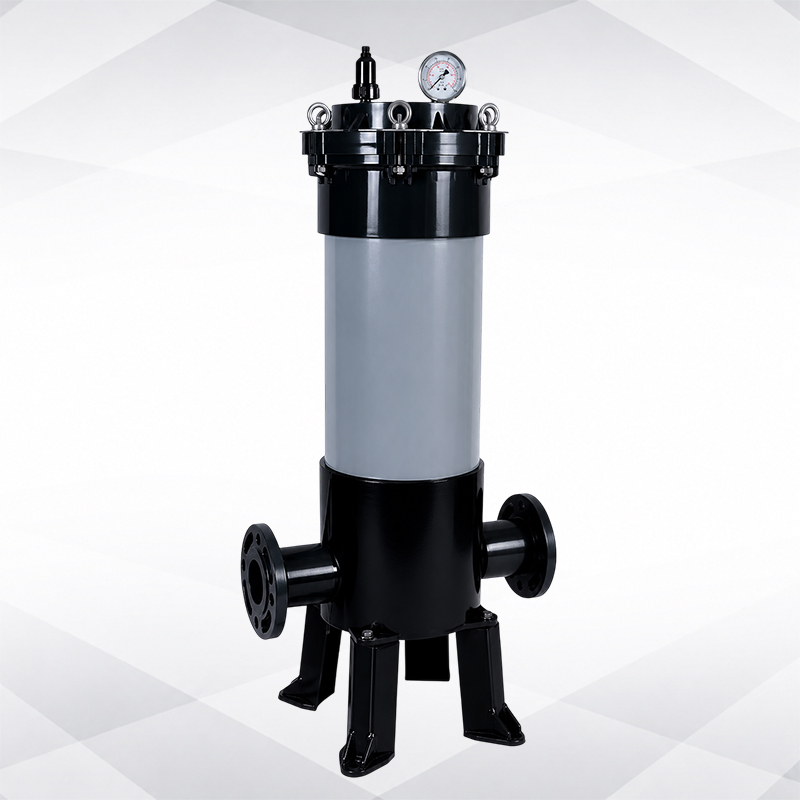
UPVC Filter Housing is a strong and corrosion-resistant housing that holds filter cartridges to remove dirt, sediments, and impurities from chemical liquids. Aris Filtration manufactures UPVC Filter Housings in Gujarat, India, offering lightweight and economical filtration solutions for industries using corrosive chemicals.
Compared with metal housings, UPVC Filter Housings resist acids, alkalis, salts, and chemicals without rust or scaling. They are widely used in water treatment, chemical processing, refineries, textiles, power plants, oil & gas, pharmaceuticals, and other industries where chemical resistance is important.
What is a UPVC Filter Housing?
A UPVC Filter Housing is a strong plastic housing that holds one or more filter cartridges to remove dirt and impurities from liquids. It is made from durable UPVC and is suitable for chemical applications where metal housings may not be practical or economical.
Key Statement: UPVC Filter Housings provide reliable cartridge filtration while offering excellent resistance to corrosive chemicals and aggressive process fluids.
Their lightweight construction, smooth internal surface, and chemical resistance make them widely used in industrial liquid filtration systems.
Why Choose UPVC Filter Housing for Chemical Filtration?
Chemical processing industries require filtration equipment that can prevent highly corrosive environments without declining over time.
Key Benefits
- Excellent resistance to acids and alkalis
- Rust-proof and corrosion-free construction
- Lightweight and easy to install
- Low maintenance requirements
- Smooth internal surface reduces scaling
- Long operational life
- Economical alternative to metallic housings
- Suitable for continuous filtration processes
These advantages make UPVC Filter Housings a preferred choice for chemical filtration and water treatment applications.
Project Gallery


How Does a UPVC Filter Housing Work?
A UPVC Filter Housing allows the fluid to pass through a filter cartridge inside the housing to remove impurities.
The filtration process includes:
1. Contaminated liquid enters the housing through the inlet connection.
2. The liquid passes through the filter cartridge.
3. Suspended particles are retained within the filter media.
4. Clean filtered liquid exits through the outlet.
5. The cartridge is replaced or cleaned once it reaches its dirt-holding capacity.
Key Statement: A UPVC Filter Housing delivers efficient micron-level filtration while protecting downstream equipment from suspended contaminants.
What are the Features of UPVC Filter Housings?
Our designs UPVC Filter Housings to provide dependable performance in corrosive process environments.
Product Features
- High-quality UPVC construction
- Corrosion and chemical resistant body
- Single cartridge configuration
- Leak-proof sealing arrangement
- Compact and lightweight design
- Easy cartridge replacement
- Low pressure drop
- Smooth internal finish
- Easy installation and maintenance
- Long service life
These features help improve process effectiveness while minimizing maintenance costs.
Which Applications are Suitable for UPVC Filter Housings?
UPVC Filter Housings are used with corrosive chemicals and where clean liquid filtration is required.
Common Applications:
- Demineralized Water Plants
- RO Pretreatment Systems
- Chemical Processing
- Electroplating Plants
- Acid Filtration Systems
- Alkaline Solution Filtration
- Surface Treatment Plants
- Water Recycling Systems
- Process Water Filtration
- Chemical Dosing Systems
How Do You Select the Right UPVC Filter Housing?
Choosing the correct filter housing improves filtration efficiency and equipment safety. Selecting the correct housing helps maximize cartridge life and maintain consistent filtration performance.
Selection Factors:
- Flow rate
- Operating pressure
- Process temperature
- Chemical compatibility
- Cartridge length
- Micron rating
- Inlet and outlet size
- Type of contaminants
- Installation space
- Maintenance requirements
Why Choose Aris Filtration for UPVC Filter Housings?
We are a leading manufacturer and exporter of UPVC Filter Housing based in Gujarat, India. We specialize in designing application-specific filtration solutions that combine durability, efficiency, and long-term accuracy.
Why Customers Choose Aris Filtration
- Manufacturer & exporter based in Gujarat, India
- Precision-engineered UPVC Filter Housings
- High-quality corrosion-resistant materials
- Custom filtration solutions
- Reliable quality guarantee
- Easy installation and maintenance
- Technical support for product selection
- Timely delivery across domestic and international markets
- Solutions customized for demanding industrial environments
At Aris Filtration, every UPVC Filter Housing is manufactured to meet the specific operating conditions of each application. Our engineering team focuses on selecting suitable materials, optimizing flow characteristics, and ensuring dependable performance in corrosive environments, helping customers achieve efficient and long-lasting filtration systems.
Frequently Asked Questions (FAQs)
(1)What is a UPVC Filter Housing used for?
A UPVC Filter Housing is used to hold filter cartridges for removing suspended particles and contaminants from corrosive liquids, process water, acids, alkalis, and chemical solutions.
(2)What are the advantages of UPVC over stainless steel?
UPVC offers excellent resistance to many corrosive chemicals, is lightweight, rust-proof, cost-effective, and requires minimal maintenance, making it suitable for many chemical filtration applications.
(3)Can UPVC Filter Housings handle aggressive chemicals?
Yes. UPVC Filter Housings are widely used for acids, alkalis, salts, and various chemical solutions, provided the chemical compatibility is verified for the specific application.
(4)Which industries commonly use UPVC Filter Housings?
They are commonly used in water treatment, chemical processing, electroplating, textile, dye & intermediates, fertilizer, mining, paint, petrochemical, sugar, and pharmaceutical industries.
(5)Can UPVC Filter Housings be customized?
Yes. Aris Filtration offers customized UPVC Filter Housings based on flow rate, cartridge size, pressure requirements, connection type, and process conditions.