

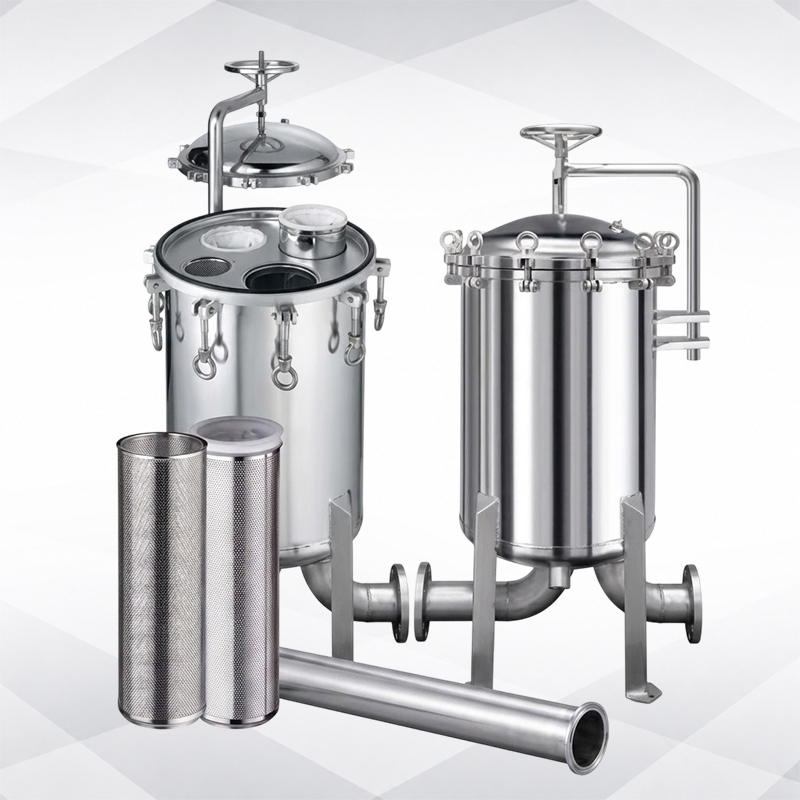
Sintered Fiber Felt Media is a porous metal filtration medium designed for demanding liquid and gas filtration applications where high permeability, depth filtration, mechanical strength, and cleanability are important. Its three-dimensional fiber structure helps retain contaminants through the media depth while maintaining efficient fluid flow.
Aris Filtration offers industrial filtration solutions for air, gas, and liquid applications from its manufacturing base in Ahmedabad, Gujarat, India. Its broader filtration portfolio includes filter housings, cartridge filters, liquid filter bags, sintered products, air filters, and other industrial filtration solutions.
What Is Sintered Fiber Felt Media?
Sintered Fiber Felt Media is a non-woven porous filtration material made by arranging fine metal fibers into a three-dimensional structure and bonding the fibers through a controlled sintering process.
Unlike conventional woven wire mesh, which primarily provides surface openings for particle retention, sintered fiber felt creates interconnected flow paths throughout the media thickness. This makes it suitable for depth filtration, where contaminants can be captured at different points within the filter structure.
The sintered structure can provide a combination of:
- High porosity and permeability
- Depth filtration capability
- High contaminant-holding capacity
- Mechanical strength
- Resistance to demanding operating conditions
- Potential for cleaning and reuse, depending on media material and application
- Consistent filtration through a controlled porous structure
Key statement:
- Sintered fiber felt is a three-dimensional depth-filtration medium that combines porous flow paths with a mechanically stable metal-fiber structure.
How Does Sintered Fiber Felt Filtration Work?
The filtration process depends on the porous fiber network rather than a single flat filtering surface.
1. Fluid or gas enters the media
The process fluid or gas reaches the upstream side of the sintered fiber felt.
2. Flow passes through interconnected pores
The three-dimensional fiber network creates multiple flow paths through the media.
3. Particles are captured within the structure
Larger contaminants can be retained in upstream regions, while smaller particles can penetrate deeper into the porous structure before being captured.
4. Filtered fluid exits downstream
The cleaned fluid or gas leaves the filter while retained contaminants remain within the media.
This depth-filtration mechanism can provide greater contaminant-holding capacity than a simple surface-filtering structure in suitable applications.
Why Choose Sintered Fiber Felt Media for Industrial Filtration?
Sintered fiber felt is particularly relevant where conventional filter media may face challenges related to pressure drop, contaminant loading, mechanical stress, temperature, or repeated cleaning.
| Feature | Filtration Advantage |
|---|---|
| 3D porous structure | Supports depth filtration |
| High permeability | Allows efficient fluid or gas passage |
| Fiber-based structure | Provides a large internal filtration area |
| Sinter-bonded construction | Improves structural stability |
| High dirt-holding capability | Helps manage contaminant loading |
| Cleanable construction* | Can support extended service in suitable applications |
| Metal construction* | Can be selected for demanding temperature or chemical conditions |
*Actual performance depends on the selected metal/alloy, media construction, filter design, process fluid, temperature, pressure, contaminant type, and cleaning method.
Important: A sintered fiber felt should be selected according to the complete process condition rather than filtration rating alone.
Where Is Sintered Fiber Felt Media Used?
Sintered fiber felt can be considered for filtration duties across a wide range of process industries.
Water Treatment
Suitable filtration configurations can be considered for process water, wastewater, pretreatment, equipment protection, and other industrial water-treatment applications, depending on contaminant characteristics and system design.
Refineries and Oil & Gas
The porous metal structure can be considered for demanding process-fluid and hydrocarbon filtration applications, particularly where mechanical durability and controlled particle retention are required.
Chemicals and Petrochemicals
Chemical-processing systems can require filtration media that is compatible with the process fluid and operating conditions. The appropriate alloy and construction should therefore be selected according to chemical compatibility.
Mining and Minerals
Mining processes can involve high solid loading and abrasive contaminants. Sintered fiber media can be evaluated where depth filtration and robust filter construction are required.
Pulp & Paper
Filtration of process liquids and protection of downstream equipment can require media capable of handling suspended contaminants while maintaining practical flow.
Power Plants
Sintered fiber filtration can be evaluated for process-water, oil, fuel, hydraulic, or equipment-protection duties, subject to the specific fluid and operating parameters.
Other Target Industries
Aris Filtration can also address filtration requirements across:
- Textiles
- Dye & Intermediates
- Edible Oils
- Automobiles
- Paints & Inks
- Aeronautics
- Cement
- Fertilizers
- Bio-Pharma
- Ceramics
- Sugar
- Defence & Marine applications
Aris Filtration states that its existing industrial filtration customers include sectors such as oil & gas, steel, textiles, mines and minerals, cement, electronics, and water treatment.
How Do You Select the Right Sintered Fiber Felt Media?
The correct media should be selected based on the complete filtration requirement.
Consider these parameters before specifying a filter:
- Process fluid or gas - Identify the material being filtered.
- Contaminant type - Determine whether the system contains solids, particles, gels, oils, or other contaminants.
- Required filtration rating - Define the required particle-retention level.
- Flow rate - Establish the required process throughput.
- Operating pressure - Check differential and system pressure conditions.
- Operating temperature - Select a suitable material for the actual temperature.
- Chemical compatibility - Confirm that the selected metal/alloy is compatible with the process.
- Cleaning requirement - Determine whether backwashing, backflushing, chemical cleaning, or another regeneration method is appropriate.
- Filter configuration - Consider sheet, cartridge, pleated, or application-specific construction.
The correct filtration media is determined by the interaction between filtration accuracy, flow requirement, contaminant loading, pressure drop, chemical compatibility, temperature, and filter design.
Sintered Fiber Felt vs. Conventional Filter Media
Sintered fiber felt differs from conventional paper, polymeric, cloth, and woven-metal media because filtration takes place through a three-dimensional porous metal-fiber network.
This structure can provide advantages where the application demands a combination of fine particle retention, permeability, mechanical strength, and repeated-service capability. The actual advantage over another media must be established through application-specific testing and operating data.
Why Choose Aris Filtration for Industrial Filter Media?
Aris Filtration is a Sintered Fiber Felt Media manufacturer and exporter based in Ahmedabad, Gujarat, India.
The company states that it works with macro- and micro-filtration technology for air, gas, and liquid applications and provides filtration products for Indian and international industrial markets. Its published portfolio covers filter housings, cartridge filters, liquid filter bags, sintered products, air filters, gas filter elements, and other filtration equipment.
Aris Filtration also states that its quality system follows quality procedures that include applicable inspection and testing activities such as liquid penetrant testing, radiography, non-destructive testing, hydro testing, surface treatment, and packing procedures.
Get Sintered Fiber Felt Media for Your Application
If you are looking for Sintered Fiber Felt Media from a manufacturer and exporter in Gujarat, India, share your application details with Aris Filtration.
For technical evaluation, provide:
- Process fluid/gas
- Required filtration rating
- Flow rate
- Operating temperature
- Operating pressure
- Contaminant type
- Existing filter specification
- Filter housing or equipment details
- Required quantity
Aris Filtration can evaluate the filtration requirement and help identify an appropriate media configuration for your industrial application.
Frequently Asked Questions
(1)What is Sintered Fiber Felt Media?
Sintered Fiber Felt Media is a porous metal filtration material made by arranging fine metal fibers into a three-dimensional structure and bonding them through sintering.
(2)Is Sintered Fiber Felt a depth filter?
Yes. Its three-dimensional porous structure allows particles to be captured within the thickness of the media rather than relying only on surface filtration.
(3)What industries use Sintered Fiber Felt Media?
It can be evaluated for applications in water treatment, refineries, oil & gas, chemicals, petrochemicals, mining, pulp & paper, textiles, power plants, paints, inks, fertilizers, cement, automobiles, edible oils, bio-pharma, sugar, ceramics, aeronautics, and marine and defence-related filtration applications.
(4)Can Sintered Fiber Felt be cleaned and reused?
Depending on the material, construction, contaminant and process conditions, sintered metal fiber media can be designed for cleaning or regeneration. The appropriate cleaning method should be confirmed for the specific application.
(5)How should I choose Sintered Fiber Felt Media?
Selection should consider filtration rating, process fluid, flow rate, contaminant loading, operating temperature and pressure, chemical compatibility, pressure-drop requirements, cleaning method, and filter configuration.
(6)Where is Aris Filtration located?
Aris Filtration's corporate office and factory are located in Ahmedabad, Gujarat, India. The company serves industrial filtration requirements in India and international markets.